
Articulated robot
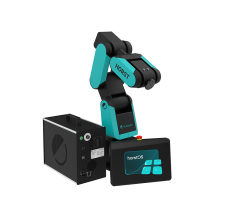

Articulated robots are among the most versatile and widely used industrial robots in modern manufacturing environments. Thanks to their multi-axis kinematics and large working range, they are ideal for complex motion sequences and a wide variety of automation tasks. Typically equipped with 4 to 6 axes, articulated robots provide high flexibility and precise positioning even in hard-to-reach areas.
They are commonly used for welding, machine tending, palletizing, assembly, pick & place, material handling, grinding, dispensing, and quality inspection applications. Their high repeatability, speed, and flexibility make articulated robots suitable for both compact robotic cells and fully automated production lines.
Modern articulated robots can be combined with grippers, sensors, vision systems, linear axes, positioners, and conveyor systems to create scalable automation solutions for industries such as automotive, metal processing, plastics manufacturing, electronics production, logistics, and food processing.
With advanced control technology and digital integration capabilities, articulated robots help companies optimize production efficiency, improve quality, and respond flexibly to changing manufacturing requirements. They are a key foundation of modern Industry 4.0 and smart factory concepts.


NEXOS.MAX — Modular Automation Exchange © 2026 | Template © 2009-2026 by modified eCommerce Shopsoftware